Gjirokaster Albania Tourism: The Complete Guide to Albania’s Stone City
Gjirokaster is one of the most visually arresting cities in the entire Balkans — a UNESCO World Heritage Site where Ottoman-era stone towers climb a steep hillside beneath a massive medieval fortress, and where the air still carries the weight of centuries of layered history. Most travelers who visit leave wondering why this city isn’t mentioned in the same breath as Dubrovnik or Mostar. The answer is simply that Albania has been slower to enter mainstream travel conversations — but that’s changing fast in 2026, and Gjirokaster is leading the charge as the country’s most compelling cultural destination. If you’re planning a trip to southern Albania, this guide covers everything you need to make the most of your time here.
What Makes Gjirokaster Albania Tourism So Compelling?
Gjirokaster sits at roughly 300 meters above the Drino River Valley, with the Gjerë mountains forming a dramatic backdrop to the east. The city’s defining visual characteristic — its steeply pitched roofs clad in heavy grey limestone slabs — gives it an almost monolithic appearance when viewed from a distance. These rooftops aren’t decorative; they were engineered to handle the weight of winter snow loads and to resist fire, which was a constant threat in densely packed Ottoman towns.
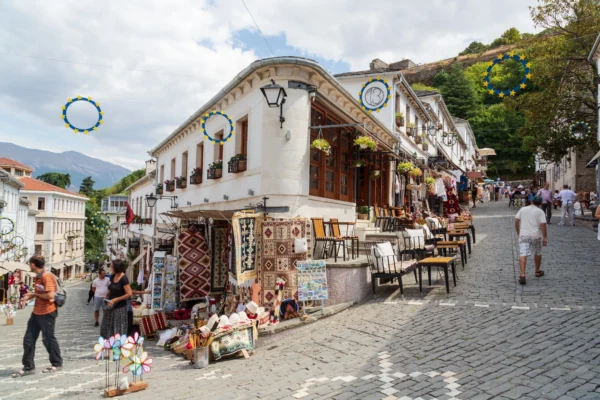
The city divides naturally into two zones. The Bazaar quarter (Pazari i Vjetër) at the lower elevation contains 18th and 19th-century merchant buildings with ground-floor workshops and upper-floor living quarters. The residential kasaba climbs steeply above, where the great tower houses — some with five or six stories — were built by wealthy beys to display status as much as to provide fortified living. Understanding this social geography makes walking the streets far more rewarding than simply following a map.
Gjirokaster also carries enormous literary significance. Ismail Kadare, Albania’s most internationally recognized novelist and a longtime Nobel Prize contender, was born here in 1936. His autobiographical novel Chronicle in Stone uses the city’s wartime occupation as its backdrop, and reading it before your visit transforms the physical landscape into something almost narrative. You’ll find his childhood home near the bazaar, now a small museum worth the modest entrance fee.
wp:image {“id”:153}

/wp:image
The Fortress: Gjirokaster Castle and What’s Inside
Gjirokaster Castle is the physical anchor of the entire city. Dating to the 12th century in its earliest incarnations, with substantial reconstruction under the Ottoman governor Ali Pasha of Ioannina in the early 19th century, the fortress is one of the largest in the Balkans by enclosed area. The climb from the bazaar takes about 20 minutes on foot via the cobbled path, and the ascent itself gives you progressively better views over the valley below.
Inside the fortress walls, several distinct attractions warrant serious attention. The National Arms Museum occupies the main keep and holds an impressive collection of weapons ranging from medieval swords to 20th-century military hardware. In the central courtyard, a captured American U-2 spy plane from the Cold War era sits on display — an incongruous but fascinating artifact that speaks to Albania’s complex mid-century geopolitics. The fortress also contains an Ottoman clock tower, a Byzantine church converted to a mosque and back again over the centuries, and spectacular panoramic terraces.
The best time to visit the castle is early morning, ideally arriving when it opens at 9:00 AM, before tour groups arrive and before the midday heat builds. Entrance fees in 2026 remain genuinely affordable at around 200 Albanian Lek (roughly €2). Allow at least two hours to do the site proper justice — rushing through it means missing the quieter corners where the stonework and views are most rewarding.
The Old Bazaar and Tower Houses
Walking the bazaar district of Gjirokaster is a different kind of experience from the fortress. Here the scale is human and intimate — narrow stone lanes, arched doorways, workshops where craftspeople still produce the copper and silver goods for which the region was historically known. Several of the tower houses have been converted to museums or guesthouses, and visiting the interior of a traditional kulla (tower house) is essential to understanding how these buildings actually functioned as domestic spaces.
The Skenduli House and the Zekate House are the two most significant tower houses open to visitors. The Zekate House in particular, dating to the 1800s, is considered one of the finest surviving examples of the Ottoman residential tradition in the entire Balkans. Its twin-towered facade, carved wooden ceilings, and tiered seating areas (sofas) offer a direct window into the daily rhythms and aesthetic values of the Albanian bey class. The family who owns the property still lives on-site and often conducts informal tours — budget a generous tip, as this represents a real act of preservation.
If you’re planning a broader southern Albania itinerary, Gjirokaster pairs naturally with Berat (another UNESCO city, approximately 70 kilometers north) and with the Butrint archaeological complex near Saranda. Our Albania 12 Day Cultural and Historic Tour covers both cities in depth alongside the Blue Eye spring and the Albanian Riviera coastline, giving you the full picture of what the south has to offer.
wp:image {“id”:37}

/wp:image
Getting to Gjirokaster: Practical Transport Information
Gjirokaster sits approximately 230 kilometers south of Tirana along the SH4 highway, which is a well-maintained two-lane road through the Gjirokastra Prefecture. The drive from Tirana takes between three and four hours depending on traffic through Fier and road conditions in the mountain sections. From Saranda on the coast, the journey is only about 60 kilometers and takes roughly 90 minutes — making it an excellent day trip or short stop if you’re traveling the Riviera.
Furgon (shared minivan) connections operate daily from Tirana’s southern bus station and from Saranda. These are comfortable, affordable, and genuinely the way most Albanians travel between cities. Scheduled departures typically run in the morning hours, with the Tirana-Gjirokaster furgon departing around 8:00 AM and 10:00 AM. A private transfer from Tirana costs approximately €60-80 for a standard vehicle and gives you flexibility to stop at points of interest along the route, including the Ali Pasha ruins near Tepelena.
Note that Gjirokaster’s old city is built on an extremely steep gradient. If you have mobility limitations or are traveling with young children, the castle approach and many residential lanes present genuine physical challenges. Comfortable, flat-soled shoes with good grip are essential — the polished limestone cobblestones become slippery when wet.
Where to Stay in Gjirokaster
The accommodation picture in Gjirokaster has improved considerably since 2022. Staying within the old city itself is strongly recommended over the modern lower town — the experience of waking up inside a stone tower house, hearing the morning call to prayer echo across the valley, and stepping directly onto medieval cobblestones is qualitatively different from staying in a standard hotel by the main road.
Several guesthouses occupy converted kulla buildings within the historic core. These properties typically offer 4-8 rooms, include breakfast (often featuring local mountain cheeses, wild honey, and fresh-baked byrek), and are managed by families with deep local knowledge. Prices in 2026 range from approximately €35-80 per night depending on room type and season, making them excellent value relative to comparable heritage properties elsewhere in southern Europe.
For travelers interested in a premium southern Albania experience, our Balkan Riviera coverage explains how Gjirokaster fits into a broader coastal and mountain circuit that takes in both the Ionian coast and the Albanian interior highlands.
wp:image {“id”:18}

/wp:image
Food and Drink: What to Eat in Gjirokaster
Gjirokastrit cuisine reflects both the Ottoman culinary inheritance and the agricultural richness of the Drino Valley. The local specialty is qifqi — small fried rice balls seasoned with dried egg yolk and herbs, traditionally eaten for breakfast or as a meze. You’ll find these at traditional lokale (informal restaurants) in the bazaar area, and they bear no resemblance to anything in the broader Albanian culinary repertoire — this is a hyper-local dish tied specifically to this city.
Lamb prepared over wood fire, slow-cooked in terracotta vessels (tavë), and accompanied by thick yogurt from local herds is the main meal of choice for most visitors. The region’s wine production is modest but genuine — look for bottles from the Permet area (approximately 50 kilometers east), where the Kallmet and Shesh i Zi grape varieties produce distinctive, full-bodied reds that rarely appear outside the country.
Coffee culture in Gjirokaster follows the southern Albanian pattern: strong, short, and consumed slowly in good company. The main square (Sheshi Çerçiz Topulli) has several cafes where locals gather throughout the day, and sitting here for an hour gives you an organic sense of the city’s social rhythms that no amount of museum-going can replicate.
Best Time to Visit Gjirokaster
April through June and September through October represent the optimal windows for visiting Gjirokaster. Spring brings wildflowers to the surrounding hillsides and mild temperatures in the 18-24°C range, while autumn delivers clear light, quieter crowds, and the harvest-season abundance that makes meals particularly good. July and August see temperatures pushing 35°C+ in the valley, and while the castle and bazaar remain functional, the heat makes extended walking genuinely taxing by midday.
Winter in Gjirokaster is underappreciated as a travel season. The city receives snowfall several times between December and February, and the grey stone buildings against a white landscape produce extraordinary photographic conditions. Most guesthouses and restaurants remain open year-round, though operating hours contract. The National Folk Festival, when held (it runs on irregular cycles, so check current scheduling), draws musicians and performers from across Albania and is one of the most culturally rich events in the country.
Gjirokaster as Part of a Broader Albania Itinerary
Gjirokaster Albania tourism works best when the city is understood not as an isolated stop but as a node in a larger southern Albanian circuit. The most rewarding itineraries spend 2-3 nights in Gjirokaster, then combine it with the Berat castle district to the north, the Blue Eye (Syri i Kaltër) spring near Muzina, the ancient ruins at Butrint, and at least two nights on the Ionian Riviera coast. This combination delivers an extraordinary density of history, landscape, and cultural experience within a compact geographic area.
If you’re considering an extended Albanian adventure, our Albania Trekking and Culture 15-Day itinerary incorporates Gjirokaster alongside the Valbona-Theth trekking circuit in the north, giving you both the alpine wilderness and the Ottoman heritage cities in a single coherent journey. And if you’re still in the early research phase, our overview of 10 Reasons Albania Should Be Your Next Adventure makes the broader case for why the country deserves serious consideration in 2026.
At Inside Balkan, our team has been designing Albania itineraries since before the country entered mainstream travel discussions. We know Gjirokaster’s guesthouses by name, the castle guards by face, and the back lanes that most visitors never find. If you want a journey through southern Albania that goes beyond the surface layer, we’re the right people to design it.
Frequently Asked Questions: Gjirokaster Albania Tourism
How many days do I need in Gjirokaster?
Two full days is the practical minimum to cover the castle, the major tower houses, the bazaar, and the Kadare museum without feeling rushed. Three days allows for a half-day excursion to the Blue Eye spring (approximately 35 kilometers west) or the Antigonea archaeological site nearby. Travelers with a deep interest in Ottoman architecture or Albanian history can easily fill four days.
Is Gjirokaster safe for tourists?
Gjirokaster is a safe destination for international visitors. Petty theft is rare, violent crime directed at tourists is essentially unknown, and the local population has a strong tradition of besa — the Albanian code of hospitality that treats guests as a protected responsibility. The usual sensible precautions apply (don’t leave valuables visible in parked cars, be aware of your surroundings after dark), but the city presents no meaningful security concerns for the vast majority of travelers.
Do I need a visa to visit Albania?
Citizens of EU countries, the United States, the United Kingdom, Australia, and most other Western nations can enter Albania visa-free for stays of up to 90 days within a 180-day period. Always verify current entry requirements through official government channels before travel, as regulations can change. Albania uses the Albanian Lek (ALL) as its currency, though Euros are widely accepted in tourist-facing businesses.
What is Gjirokaster famous for?
Gjirokaster is internationally recognized for three things: its status as a UNESCO World Heritage City (inscribed in 2005) for its exceptional preservation of Ottoman-era architecture; its medieval fortress, one of the largest in the Balkans; and as the birthplace of Nobel-nominated novelist Ismail Kadare. Within Albania, it also holds significance as the birthplace of Enver Hoxha, the communist dictator who ruled the country from 1944 to 1985 — his former residence now serves as a museum of the communist period.
Can I visit Gjirokaster as a day trip from Saranda?
Yes, the 60-kilometer drive from Saranda takes approximately 90 minutes and makes Gjirokaster a viable day trip. However, day-trip visitors consistently report wishing they had stayed overnight — the city’s character changes dramatically in the evening when tour groups depart, and the quality of light in the early morning hours is extraordinary for photography. If your schedule allows even one night, the overnight experience is strongly recommended over a day trip.
What language do people speak in Gjirokaster?
Albanian is the primary language, specifically the Tosk dialect that characterizes all of southern Albania. Given Gjirokaster’s proximity to the Greek border (approximately 30 kilometers), Greek is widely spoken as a second language, particularly among older residents and in commercial contexts. English is understood in hotels, major restaurants, and by younger residents, though having a few basic Albanian phrases — faleminderit (thank you), mirë dita (good day) — is appreciated and often rewarded with genuine warmth.

Garyalb86
Travel writer and Balkan enthusiast sharing stories and tips from Albania and beyond.
View All Posts