Albania UNESCO Sites: Butrint, Berat, Gjirokastra Explored
Greece has the Acropolis. Italy has the Colosseum. Turkey has Ephesus. And Albania? Albania has three UNESCO World Heritage Sites that most European travelers have never heard of — which means you get all the historical weight without the selfie sticks and €25 gelato. Butrint, Berat, and Gjirokastra represent some of the most layered, genuinely atmospheric heritage destinations in the entire Balkans, and we’d argue they deserve a place in the same conversation as their more famous Mediterranean neighbors. If you’re researching an Albania UNESCO World Heritage sites guide, you’re already ahead of the crowd. Let us walk you through what these three places actually are, why they matter, what most visitors completely overlook, and how to visit them properly.
Why Albania Has Three UNESCO Sites and Most People Know Zero of Them
Albania spent roughly four decades under one of Europe’s most isolated communist regimes, which meant limited international tourism infrastructure and even more limited global visibility. When the country opened up in the early 1990s, it was playing catch-up on every front. The heritage, however, was always there — and UNESCO recognized it. Butrint was inscribed in 1992, followed by Gjirokastra and Berat (jointly) in 2005. Together, these three sites tell a story that spans Illyrian settlements, Greek colonization, Roman empire-building, Byzantine Christianity, and five centuries of Ottoman urban culture. That’s roughly 2,500 years of layered human history in one small country — and it makes Albania genuinely compelling for anyone interested in how civilizations stack on top of one another. This depth is a big part of what makes Albania worth putting on your travel list well ahead of more saturated destinations.
Butrint: The Archaeological Park You Won’t Want to Leave in Two Hours
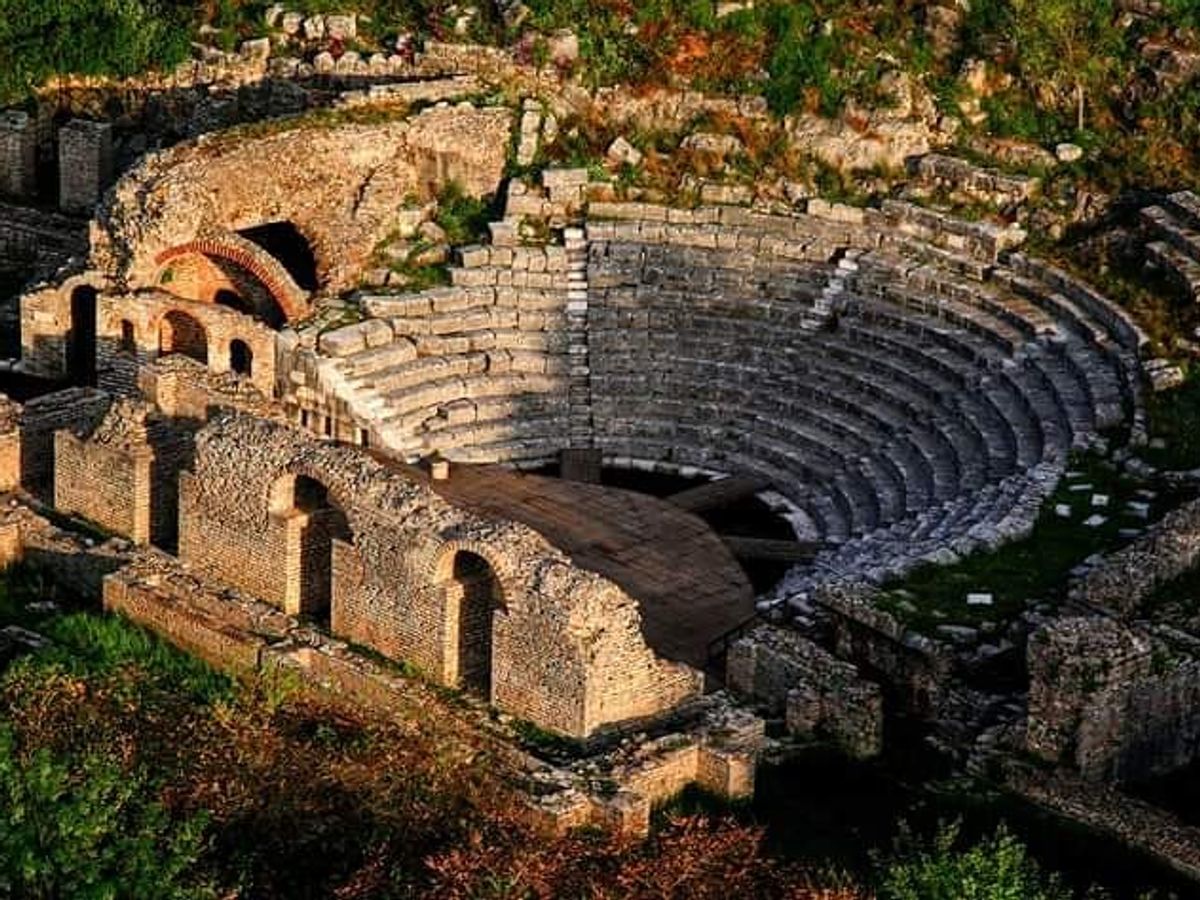
Most tour itineraries give Butrint three hours. We’ll be honest — that’s not enough. Butrint National Park sits on a wooded peninsula in the south of Albania near the Greek border, and it contains one of the most complete sequences of ancient urban archaeology anywhere in Europe. Greek, Roman, Byzantine, Venetian — each layer is physically visible, often literally on top of the last.
What You’re Actually Looking At
The site was first settled around the 8th century BC as an Illyrian settlement before becoming a Greek colony associated with the mythological Trojan hero Helenus. By the Roman period it had grown into a proper city — Julius Caesar granted it Roman colony status — and you can still walk the baptistery, the theater, the forum, the city walls, and the Venetian tower that punctuates the skyline. The baptistery floor contains one of the most detailed early Christian mosaic floors in the entire region, featuring intricate geometric and animal motifs. It’s often partially covered with protective sand between major excavation seasons, so timing matters.
What Most Visitors Miss
The majority of visitors stick to the main archaeological loop near the entrance and skip the walk up to the Venetian castle at the top of the hill. That’s a mistake. The view from the castle over the lagoon, the Vivari Channel, and across to Corfu on a clear day is one of the most quietly spectacular views in southern Albania. Also frequently skipped: the outer city walls on the far side of the loop, where Hellenistic fortification stonework survives in near-original condition. The sheer scale of the blocks used tells you more about ancient engineering capacity than any museum display.
Visiting Logistics for Butrint
- Location: 18 km south of Saranda, near the village of Butrint
- Entrance fee: Approximately 1000 ALL (around €8-10) for foreign visitors — fees are subject to seasonal adjustment
- Opening hours: Generally 8:00 AM to sunset, year-round, though hours can shift in winter
- Getting there: Furgon (shared minibus) from Saranda, taxi, or organized tour — the road through the Butrint nature reserve is part of the experience
- Best time to visit: Spring and autumn for comfortable temperatures and fewer crowds; summer gets busy with travelers coming from Saranda and the coast
- Allow: Minimum 3 hours; 4-5 hours if you want to do it properly
wp:image {“id”:369}
/wp:image
Gjirokastra: The Stone City That Wasn’t Built for Tourists
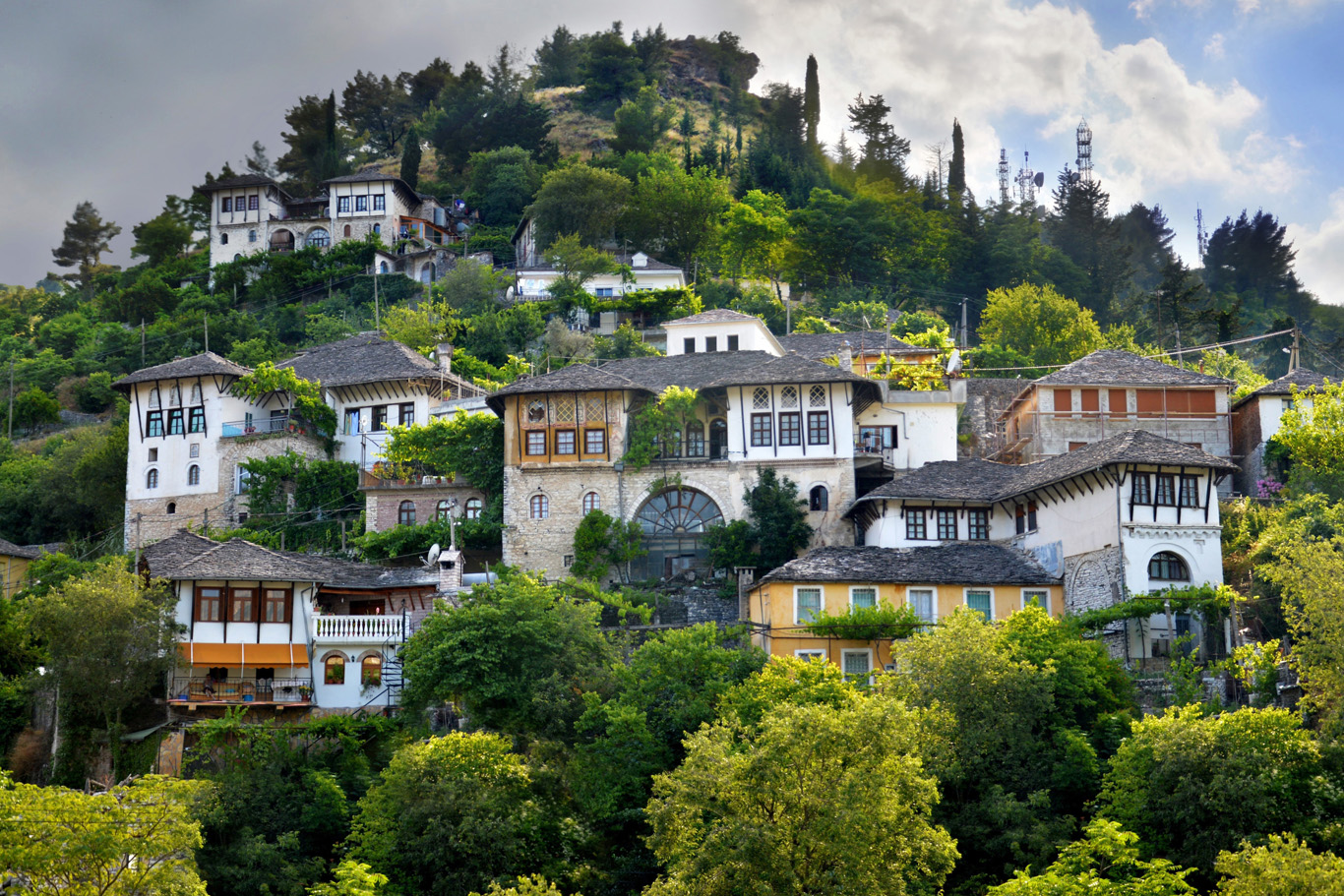
Gjirokastra is one of those places that would feel staged and artificial if it weren’t completely genuine. The entire old city is built from local limestone — the rooftops, the walls, the steep cobbled streets — and it climbs up a hillside in the Drino Valley in a way that feels almost defiant. The citadel at the top has commanded that valley since at least the 4th century. UNESCO inscribed Gjirokastra alongside Berat as a “rare example of an Ottoman urban ensemble,” and it’s a designation that holds up the moment you walk the bazaar quarter.
The Ottoman and Illyrian Layers
What makes Gjirokastra unusual even within the Balkans is the continuity of its urban fabric. This wasn’t a city rebuilt after conflict — much of the 17th and 18th century architecture is intact because Gjirokastra was sufficiently remote to be left alone. The tower houses (kullë) that define the skyline are distinctive: they’re multi-story defensive structures built by wealthy local families during the Ottoman period, with thick stone walls, iron-shuttered windows, and internal cisterns designed for sieges. The Skënduli House and the Zekate House are both open to visitors and give you an unfiltered look at how elite Albanian families lived under Ottoman rule.
The Citadel and What’s Inside
Gjirokastra’s castle is more than a viewpoint — it houses the National Museum of Armaments, which contains an eclectic collection ranging from ancient weapons to a captured US Air Force reconnaissance plane from 1957, a relic of Cold War tensions that Enver Hoxha’s regime displayed as a propaganda trophy. It’s a jarring but genuinely fascinating exhibit. The castle also hosts the National Folklore Festival, which runs every five years and draws performers from across Albania — if your visit happens to coincide, don’t miss it.
What Most Visitors Miss in Gjirokastra
The bazaar quarter below the castle gets decent foot traffic, but most visitors don’t walk far enough into the residential neighborhoods where the larger tower houses are. The Palorto neighborhood in particular has some of the finest surviving Ottoman-period architecture in Albania, and it’s genuinely quiet — you can walk those lanes for an hour and have them largely to yourself. Also undervisited: the Old Bazaar’s lower section, where a handful of craftspeople still work in traditional occupations including coppersmithing.
Visiting Logistics for Gjirokastra
- Location: 232 km south of Tirana, in the Gjirokastër region
- Citadel entrance fee: Approximately 200-300 ALL (under €3) — highly affordable relative to the experience
- Getting there: Bus or furgon from Tirana (4-5 hours) or from Saranda (1.5 hours); the route from Saranda via the Blue Eye spring is worth taking
- Stay at least one night: The city changes character completely at dusk when the day-trippers leave and the limestone glows in the evening light
wp:image {“id”:368}
/wp:image
Berat: The City of a Thousand Windows and What That Actually Means
Berat’s nickname — the City of a Thousand Windows — refers to the rows of large, multi-paned Ottoman windows that face outward from the hillside neighborhoods, creating a stacked, almost theatrical visual effect. It looks like a film set. It is not a film set. People have been living in these houses for centuries, and many still do. That’s the thing about Berat that catches visitors off guard: it’s a living UNESCO site, not a preserved museum.
Three Districts, One UNESCO Inscription
Berat’s inscription covers three distinct areas: Mangalem (the Muslim quarter on the west bank of the Osum River), Gorica (the Christian quarter on the east bank), and Kala (the castle district on the hill above). Each has its own architectural character. Mangalem’s houses with their characteristic windows define the classic Berat image. Gorica’s narrow lanes are quieter and less photographed. Kala is where things get genuinely fascinating — it’s an inhabited castle complex with Orthodox churches, a mosque, Byzantine ruins, and about 300 residents who have lived within the castle walls for generations.
The Onufri Museum: Don’t Skip This
Inside the Kala, the Church of the Dormition of St. Mary houses the Onufri Museum, dedicated to the 16th-century Albanian iconographer Onufri, whose use of a vivid, distinctive red pigment — sometimes called “Onufri red” — set his work apart from Byzantine contemporaries. The museum holds around 170 icons and ecclesiastical artifacts and is one of the finest collections of Orthodox Christian art in the Balkans. Many visitors to Berat don’t realize it exists. That’s an error worth correcting.
What Most Visitors Miss in Berat
The Gorica quarter across the river is almost always quieter than Mangalem, and the walk across the old stone bridge and up through Gorica’s lanes offers the best elevated views back across to the Mangalem facades. Most day-trippers photograph Mangalem from a distance and leave without crossing. Also frequently missed: the Byzantine-era ruins within Kala itself, particularly the remnants of the 13th-century church foundations near the castle’s northern walls.
Visiting Logistics for Berat
- Location: 122 km south of Tirana
- Castle/Onufri Museum entrance: Around 200 ALL for the castle area; the museum has a separate small fee
- Getting there: Regular buses from Tirana (2-2.5 hours); Berat is also a natural overnight stop on routes between Tirana and Gjirokastra
- Combination tip: Berat and Gjirokastra work beautifully as a two-city southern Albania itinerary of 3-4 days
wp:image {“id”:370}
/wp:image
How These Three Sites Fit the Broader Albanian Historical Narrative
Taken together, Butrint, Gjirokastra, and Berat trace a historical arc that’s genuinely unique in the Balkans. Butrint represents the deep pre-Ottoman and pre-Slavic layers — Illyrian, Greek, Roman, Byzantine — that place Albania within the ancient Mediterranean world. Gjirokastra and Berat then show what happened when five centuries of Ottoman administration met an existing Balkan Christian culture: not erasure, but a complex syncretism visible in the architecture, the religious buildings, and the urban layout. The survival of so many Orthodox churches within Ottoman-era cities is not incidental — it reflects the relatively pragmatic approach to religion in Albanian urban centers, a dynamic quite different from what you find in many neighboring countries. This historical texture is a core reason why we think Albania is worth exploring over a proper multi-day itinerary rather than squeezing into a long weekend.
It also connects directly to why we place Albania at the front of the pack for Balkan heritage travel — something we explore in depth in our argument for Albania leading the Balkans in historic depth and heritage.
Guided Tours vs. Independent Visits: What We Recommend
All three sites are technically accessible independently, but context makes a significant difference here. Butrint in particular benefits enormously from a guide who can walk you through the archaeological phases — without that, the layers blur together quickly. Gjirokastra’s tower houses have histories that aren’t explained by the minimal on-site signage. Berat’s Onufri collection requires some knowledge of Byzantine iconography to fully appreciate.
Our UNESCO Albania Three Cities of Stone tour covers all three sites with specialist local guides who know these locations well beyond the standard script. If you prefer a longer, more immersive route that builds these UNESCO sites into a full exploration of Albanian culture and landscape, our Albania Trekking and Culture 15-day itinerary integrates all three alongside the northern highlands and the Riviera.
For independent travelers who want to self-guide: hire a local guide for at least half a day at each site. The fees are modest (typically €20-40 for a half-day) and the difference in what you take away from the visit is substantial.
Practical Timing: When to Visit Albania’s UNESCO Sites
Spring (April–June) and autumn (September–October) are the sweet spots. Summer works well for combining the UNESCO sites with the Albanian Riviera coast, but Butrint in particular gets crowded in July and August with Saranda-based beach tourists who bolt it on as a day trip. If you’re primarily there for the archaeology and architecture rather than the beach combo, shoulder season gives you more space and more pleasant walking temperatures — particularly important in Gjirokastra and Berat where you’ll be covering significant elevation on foot. For month-by-month guidance on the wider region, the Balkans month-by-month travel guide breaks down conditions across all destinations.
Frequently Asked Questions
Can I visit all three UNESCO sites in one trip?
Yes, and we’d strongly recommend it. A well-structured southern Albania circuit covers Berat, Gjirokastra, and Butrint (via Saranda) in 5-7 days comfortably. Add an extra day or two and you can also take in the Blue Eye spring, the Riviera coast near Himara, and Gjirokastër’s surrounding villages.
Do I need to pre-book entrance tickets?
Not currently — all three sites operate on walk-up admission. That said, guided tours should be pre-arranged, especially in peak season when local guides book up. Contact us at insidebalkan.com to arrange guided access with specialists who work these sites regularly.
Is Albania safe for independent travel around these sites?
Yes. The areas around all three UNESCO sites are among the most visited and consequently most well-serviced parts of Albania for tourists. Standard travel precautions apply but there are no specific safety concerns.
How does Albania compare to other Balkan heritage destinations like Dubrovnik or Kotor?
That’s a genuinely interesting comparison — and if you’re weighing your options, our piece on Albania versus Croatia for travelers addresses it directly. The short answer: Albania offers comparable historical depth with considerably fewer crowds and considerably lower prices.
Can I get good accommodation near each site?
Berat and Gjirokastra both have excellent boutique guesthouses within walking distance of the UNESCO zones — some of them housed in restored Ottoman-period buildings. Butrint itself has no accommodation, so Saranda (18 km away) is the base. Saranda has a wide range of hotels across all price points.
Ready to plan your Albania UNESCO heritage trip properly? Visit insidebalkan.com to browse our tour options or reach out directly through the site to discuss a custom itinerary built around your timeline and interests.

Garyalb86
Travel writer and Balkan enthusiast sharing stories and tips from Albania and beyond.
View All Posts